Idaho Power / SWIP-N Point by Point Rebuttal Part 2
Part 2 - Idaho Power Points 5-8, (9-13 coming soon)
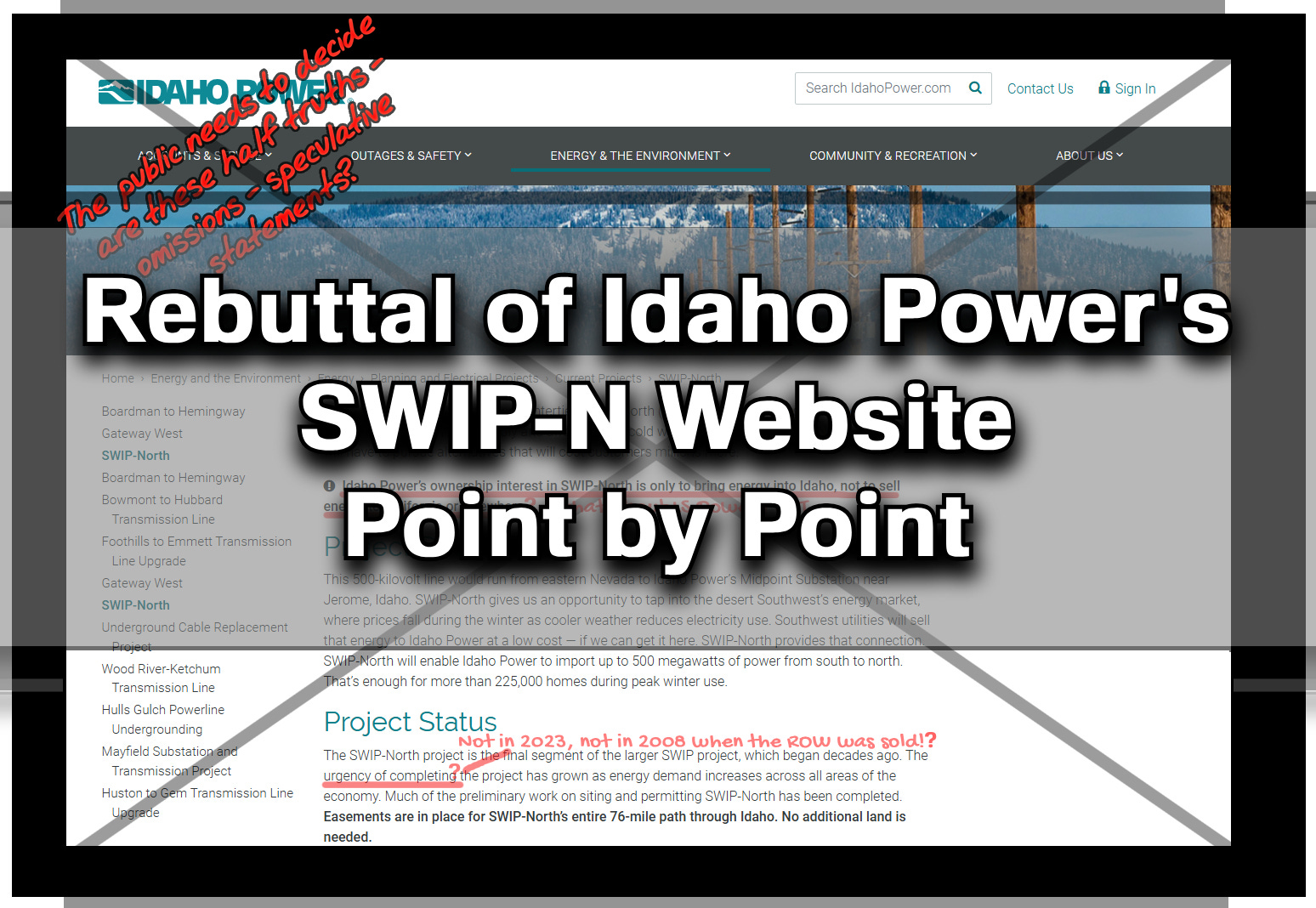
The following questions and answers are quotes from Idaho Power marketing of the SWIP-N powerline, an attempt to convince Idaho residents of the value of SWIP-N. The Response is an analysis of Idaho Power’s answers.
Idaho Power - Point 5
“SWIP-North will help keep energy affordable while meeting the growing energy needs of homes, farms, and businesses in the Magic Valley. Transmission investment also brings long-term local benefits. The project will generate new property tax revenue for counties and schools.”
Response: Maybe, but at what cost?
Idaho Power’s statement that SWIP North “will help keep energy affordable while meeting the growing energy needs of homes, farms, and businesses in the Magic Valley” is a prediction, not a proven outcome. The company offers no quantitative evidence that the project will lower bills for local residential or agricultural customers. None of Idaho Power’s filings with the Idaho Public Utilities Commission demonstrate that SWIP North provides a measurable reduction in retail rates, and no regulatory body has concluded that the line is necessary for affordability.
The claim relies on assumptions rather than verified data and reports that have not been available for scrutiny. Idaho Power has never produced a rate impact analysis that compares SWIP North to alternative resource investments such as new dispatchable generation, smaller scale transmission upgrades, distributed energy resources, targeted winter capacity additions, or demand side efficiency. Without such a comparison, the statement that SWIP North “will keep energy affordable” is not grounded in any regulatory finding. It is a forward looking assertion based on internal modeling that has not been tested or confirmed by the Commission.
The company also uses the phrase “meeting the growing energy needs of homes, farms, and businesses” without acknowledging the documented cause of the projected one thousand megawatt increase in peak load over the next five years. Idaho Power’s own Integrated Resource Plan shows that industrial expansion, including Micron’s new fabrication campus and the entrance of large data centers, accounts for a significant share of that growth. These loads are hundreds of times larger than a typical home or farm. Presenting SWIP North as a response to the everyday needs of Magic Valley families obscures the fact that the primary drivers of new transmission investment are large industrial customers with extraordinary demand profiles.
Idaho Power’s additional claim that transmission investment “brings long term local benefits” through property tax revenue is also speculative. Transmission lines are capital intensive assets, and the revenue requirement from those investments is passed through to ratepayers over decades. Property tax payments to counties are small compared to the long term cost recovery that is added to customer bills. The company has not provided a net benefit calculation that balances the tax revenue against the decades of rate base recovery that Idaho customers will pay. Without that comparison, this statement cannot be treated as evidence of local economic gain.
Finally, Idaho Power has produced no analysis quantifying how SWIP North specifically benefits Magic Valley customers as opposed to serving broader regional transmission objectives. The project is part of a larger multi state corridor developed by LS Power and is tied to regional market flows that include the export of Idaho wind to out of state markets. Idaho Power has not demonstrated that Magic Valley customers receive unique or superior value from a line that primarily moves bulk power across long distances.
Arguably, the best alternative to SWIP-N is the investment in new dispatchable gas generation facilities. The cost of generation is less than purchased solar and wind and the construction of comparable solar and wind, made dispatchable, is near or equivalent to the cost of gas generation facilities.
Idaho Power - Point 6
“Is Idaho Power building SWIP-North to send energy to California? No… Our ownership stake does not involve selling energy to California or anywhere else.”
Response: Framing Lacking Transparency
Idaho Power repeats its ownership framing but leaves out what CAISO, DOE, and LS Power say they are building.
CAISO’s 2022-2023 Transmission Plan addendum and related memoranda describe the Southwest Intertie Project North as a transmission project selected to meet public policy and reliability needs, with DOE support, and emphasize its role in connecting new renewable resources to California and regional load. DOE’s announcement of SWIP-North being chosen for the Transmission Facilitation Program explicitly highlights its role in moving wind, solar, and geothermal resources to load centers.
Brattle’s market report for Great Basin analyzes SWIP-North as a way to deliver Idaho wind to CAISO at an estimated 40 dollars per MWh, a figure that assumes energy sales into California markets.
The LS Power Nevada Transmission overview slide deck shows SWIP-North as part of a three-phase Southwest Intertie Project with about 2,100 MW of transfer capacity, noting that when completed LS Power would be entitled to roughly 1,100 MW from Midpoint to Harry Allen, an onward path to CAISO.
FERC’s January 2025 order accepting the CAISO Great Basin Development Agreement ties SWIP-North directly to a DOE capacity contract that will fund about 22.8 percent of project cost in exchange for entitlements that DOE will later remarket. That structure only makes sense if SWIP-North is expected to move power in both directions to wherever the market value is highest, including California.
So Idaho Power may be technically accurate when it says that its current contract rights do not include exports. But that is not the same as saying SWIP-North is not being built to send energy to California. The public record shows that the project as a whole is designed, justified, and financed as a bidirectional corridor serving CAISO and regional markets.
Idaho Power - Point 7
“Q. Why doesn’t Idaho Power just build more local energy resources? We are… SWIP-North is a critical piece of our ability to continue delivering affordable energy.”
Response: An Attempt to Change the Record, a New Reality?
Again, this is not what the IRP actually says.
The 2023 IRP, filed with IPUC and OPUC and acknowledged in IPC-E-23-23, lays out a preferred portfolio that does not include SWIP-North because “Idaho Power’s potential involvement in the project remains uncertain.”
The same IRP emphasizes local and regional projects such as B2H and Gateway West, continued use of existing hydro, new gas, battery storage, and demand-side management as parts of a balanced resource strategy.
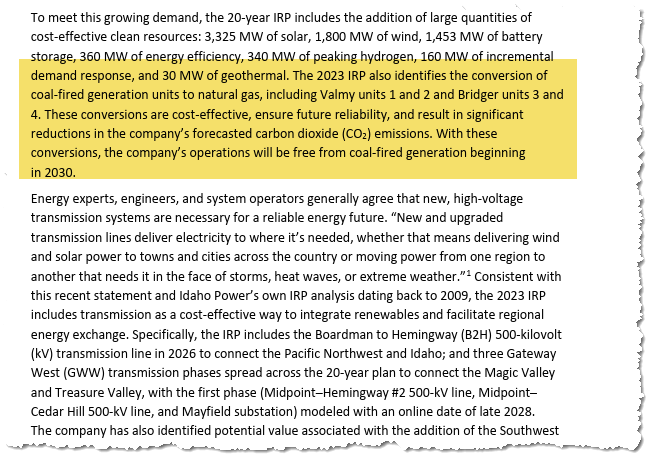
Idaho Power’s separate CPCN application for the Bennett Gas Expansion Project seeks authority to add gas capacity as a capacity resource, showing that the company considers local generation a viable alternative or complement to imports over SWIP-North.
So the IRP framework is “all of the above,” but it treats SWIP-North as one contested option among several, not as a “critical piece” without which the system cannot be reliable or affordable.
Idaho Power - Point 8
“Why doesn’t Idaho Power build Gateway West instead of SWIP-North? Gateway West will help move energy inside the Mountain West. SWIP-North will bring energy into southern Idaho from outside the region.”
Response: More Partial Truth
This is a partial, mayby misleading answer.
Idaho Power’s own documents describe SWIP-North as connecting Idaho to Nevada and, by extension, to the Las Vegas area and the broader Desert Southwest market. LS Power, DOE, and CAISO documents all describe SWIP-North as part of a long-planned intertie between the Desert Southwest, Idaho, and the Pacific Northwest, with bi-directional flows and significant export capability toward California.
Saying “SWIP-North brings energy into southern Idaho” ignores the other half of the equation: it also carries energy out of Idaho when market prices and dispatch orders make exports more profitable. That is explicitly how DOE and CAISO justify the line.
Gateway West does serve a different main purpose, improving intra-regional transfer capability between Idaho and Wyoming and strengthening connections within the Mountain West. The honest comparison is not “import line versus internal line,” but “one interregional corridor that explicitly connects Idaho to CAISO via LS Power versus another that reinforces regional reliability without tying Idaho as directly into CAISO’s export machine.”
Read Part 1:
Related
Disclaimer
This analysis uses only publicly available documents, including Idaho Power’s IRP filings, its CPCN application, Micron Technology’s petitions to intervene, federal agency reports, and published statements from Idaho Power and LS Power. The review does not claim access to confidential customer information, internal Idaho Power communications, or proprietary economic data. References to semiconductor power requirements are based on widely documented industry norms, not confidential Micron specifications. Nothing in this document should be interpreted as an accusation of wrongdoing by Idaho Power, Micron, LS Power, or any regulatory agency.
The purpose of this material is to help the public evaluate Idaho Power’s claims about SWIP North by comparing them to the official record. The analysis focuses on transparency, factual accuracy, and whether Idaho Power’s public statements are fully supported by the evidence submitted in regulatory proceedings.
Sources
- Originally published on Substack: https://jeffapierson.substack.com/p/idaho-power-swip-n-point-by-point-458